

Author guidelines
As part of the submission process, authors are required to check off their submission's compliance with all of the following items, and submissions may be returned to authors that do not adhere to these guidelines.
- General information
- General paper format
- Equations, mathematics and number formats
- Figures and tables
- Citations and references
- Use of generative AI
- Authorship and originality declaration
- Guidelines for authors prior to submitting to "Komunikácie”
- Attachments
General information
- The submissions have not been previously published, nor is it before another journal for consideration (or an explanation has been provided in comments to editor section).
- All research conducted for the submissions complies with the ethical guidelines, including compliance with the legal requirements of the country of study.
- Authors agree to prepare their article in accordance with the current journal template published on our website.
- Authors will carefully check their article for correct English grammar. Articles with poor grammar will be immediately rejected.
- Authors carefully cite all research and scientific works used in their article.
- All submissions have to deal with the topic of multidisciplinary research and engineering in transport and be submitted strictly within one of the listed subtopics. Please, refer to the list of topics and subtopics and indicate it clearly when submitting your paper.
- Only original research articles (should present the results of the original research study) are accepted for publishing.
- Two reviewers have to be suggested in the comments to editor section. Submit the reviewers´ suggestions of scientists from different countries than those of the authors who could evaluate the work and they are not based on the funding body of the manuscript.
- For all submissions a standard single-anonymised peer review procedure by at least two independent reviewers and language correction is mandatory.
- After reviewing and incorporating the editors‘ comments, the final draft (before printing) will be sent to authors for final review and minor adjustments.
- We do not allow correspoding author to have more than two manuscripts appear in a peer review procedure at the same time. Submission of new manuscript can be made after successful manusripts publication.
- The Article Processing Charge (APC) is 400 Euro (price excluding VAT). For confirmation of your willingness to pay the APC if your manuscript is accepted for publication in our journal, it is necessary to use one of the files listed in the attachment.
General paper format
- A Word or LaTex file and a PDF file are required for submission. The content of each file must match exactly.
- The text of submissions has to be format A4, splitting into two columns, Times Roman size 9, simple line spacing, page margins 2.5 cm, employs italics, rather than underlining (except with URL addresses), and all illustrations, figures, and tables are placed within the text at the appropriate points, rather than at the end.
- Do not use styles and limit formatting to minimum (bold for section headings, figure and table captions).
- The submissions written in good English have to include the following sections (among others): Abstract, Keywords, Introduction, Literature review, Methodology, Results, Discussion, and Conclusion also written in English.
- The abstract (resume) does not have to exceed 10 lines.
- Please provide minimum three up to maximum seven keywords which express the principal topics of the paper.
- Where available, URLs for the references were provided.
- The uncommon abbreviations have to be defined the first time they are used in the text. If necessary, we recommend listing the list of abbreviations in an appendix.
- The text of submissions adheres to the stylistic and bibliographic requirements outlined in the Author Guidelines.
- The submissions have not to exceed 8 pages (including figures, graphs, list of references, appendix, etc.). The cost of one additional page, designed according to the requirements of the journal, is 50.00 Euro (price excluding VAT).
- The template of submissions can be found in the attachment.
Equations, mathematics and number formats
- Mathematical symbols and equations should follow standard formatting rules (use of italics and bold) and the use of inline mathematic equations and expressions limited to a necessary minimum.
- Scalar variables in the text are set as italic (e.g. rcorr or A5), vector is set as boldface (e.g. F , a or v1) and matrices or tensors are set as boldface Arial (e. g. Z)
- Use decimal point instead of decimal comma in numbers, e.g. 0.367 and not 0,367.
- All equations, with the exception of inline expressions, have to be numbered in a chronological order using numbers in brackets - (1).
- Equations may be submitted only in Word and Mathtype formats and must be editable, i.e. not embedded as figures.
- Only SI units are allowed, using multiplication and negative powers instead of /, e.g. kg.m-3 and not kg/m3. If imperial units are necessary, then a conversion to an appropriate SI unit must be provided.
Figures and tables
- All figures and tables shall be numbered in chronological order, contain a concise caption and referenced in the text. Place the tables and figures in positions that you consider appropriate given content.
- Where possible always try to use table and figure widths of 7.5 cm or 16 cm; the editor reserves the right to reformat figures and tables that are not of the indicated width.
- Figures, graphs and diagrams, if not processed in Microsoft WORD, must be sent in electronic form (as JPG, GIF, TIF, TTF or BMP files). Photographs for publication must be either contrastive or on a slide.
- We require that the graphics of the graphs and diagrams be uniform.
- Where possible use vector or high-resolution graphics for good publishing quality and reliability.
- Figures should contain only English text and correct mathematical symbols (e.g., a hyphen "-" instead of an em-dash "–" and a decimal point instead of a comma).
- The content of the figure must be complete, and individual elements (characters) must not be obscured.
- Strict compliance with copyright is required when using figures. Using figures without proper license or explicit permission is prohibited and carries significant legal risk, as copyright holders actively use software to detect unauthorized use. As a result, retrieving figures directly from search engines (e.g. Google Images) is not permitted. In addition, all licensed content must be supported by documented proof of license and the appropriate usage agreement. Please upload the necessary documents authorizing the use of figures when submitting your article to the editorial system. Failure to comply with these standards exposes the journal Komunikacie / Communications to liability.
- Any use of third-party content, including content generated or modified using AI, must be appropriately cited and must comply with applicable copyright requirements.
- Tables should use only horizontal lines to separate the table heading from the body of the table and at the bottom of the table. No colours or other formatting are permitted on tables; when highlighting is required you may use special symbols such as "^", "†", "‡", etc.
- Do not embed tables as figures; all tabulated information must be in editable format. Using Figure captions for graphics containing tabulated information is not acceptable.
- All figures, diagrams, and tables should have a brief, explanatory title and caption. Any special characters or symbols within them (e.g., *, **, †, ‡, #) must be explained in the caption.
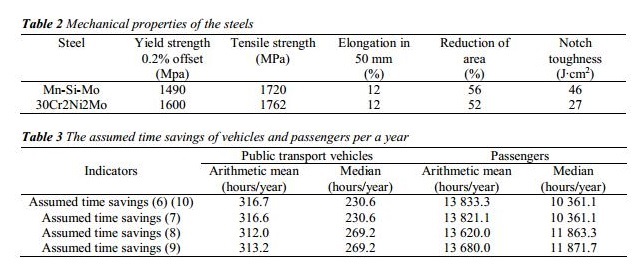
Table formatting examples
Citations and references
- All information and data that are not author's original data or contribution shall be appropriately and clearly referenced. All manuscripts are submitted for an originality check.
- Please ensure that you include a sufficient number of recent references to place your article in the context of current research.
- Please maintain an appropriate level of self-citation by the authors of the articles or our journal.
- Please ensure that you include an appropriate number of references to articles published in our journal to demonstrate the relevance of your articles to the journal's scope.
- Do not include references that are not relevant to your article. Carefully check the accuracy of each reference and ensure that it has not been taken down, as taken down references may compromise the validity of your article. Articles submitted with taken down references will be returned to the author for removal of such references or may be rejected if the validity of the research is affected.
- High impact sources are required for citing.
- Format references according to the ISO 690 standard.
- The numbered reference citation within text should be enclosed in square brackets and used in chronological order. The reference list should appear at the end of the article (in compliance with ISO 690 standard).
- Provide names of all authors of the references.
- For citing of multiple sources use [1,5,7] or [1-3] depending on the order of references you are using.
- Authors should ensure that each reference contains sufficient information for identification, that a consistent style is maintained throughout the reference list, and that the basic principles of reference formatting are followed.
- The following format shall be used for all references:
Journal paper
[1] DOBRUCKY, B., OTCENASOVA, A., POKORNY, M., TABACEK, R. The new possibilities of dynamic compensation and regeneration of energy in electric traction. Communications - Scientific Letters of the University of Zilina [online]. 1999, 1(1), p. 5-12 [accessed 2026-09-14]. ISSN 1335-4205. Available from: https://doi.org/10.26552/com.C.1999.1.5-12
Book
[2] GILLESPIE, T. D. Fundamentals of vehicle dynamics. Warrendale, PE, USA: SAE International, 1992. ISBN 978-1-56091-199-9.
Conference paper
[3] SOUFFRAN G., MIEGEVILLE L., GUERIN P. Simulation of real-world vehicle missions using a stochastic Markov model for optimal powertrain sizing. In: 2011 IEEE Vehicle Power and Propulsion Conference: proceedings [online]. IEEE. 2012. ISBN 978-1-61284-248-6. Available from: https://doi.org/10.1109/VPPC.2011.6043130
Edited book or monograph
[4] MITSAKIS, E., KOTSI, A. Cooperative intelligent transport systems as a policy tool for mitigating the impacts of climate change on road transport. In: Data analytics: paving the way to sustainable urban mobility. [online]. NATHANAIL, E. G., KARAKIKES, I. D. (Eds.). Cham: Springer, 2018. p. 418-425. eISSN 978-3-030-02305-8. Available from: https://doi.org/10.1007/978-3-030-02305-8_51
Webpage
[5] Transport - Wikipedia [online] [accessed 2019-02-21]. Available from: https://en.wikipedia.org/wiki/Transport
Use of generative AI
- Authors must declare the use of generative AI in this section of their manuscript.
- The statement must be concise, specific, accurate, and fully consistent with the information provided elsewhere in the manuscript. Authors must confirm that they have reviewed and edited all AI-generated content and that they take full responsibility for the content of the published article.
- If AI tools were used as part of the research process, their use must be described in sufficient detail in the Methodology section to allow the research process and results to be reproduced.
- Authors must ensure that the use of any AI tools is clear and transparent to readers.
- AI tools must not be used to create, alter, or manipulate images. Adjustments to brightness, contrast, or color balance are acceptable, provided that they do not obscure, remove, or introduce any information present in the original image. Any such adjustments must be disclosed in the relevant figure or image description.
- This declaration does not apply to the use of basic tools for routine tasks such as grammar and spelling checking, reference formatting, or language translation, provided that such tools do not generate or substantially alter the intellectual content of the manuscript.
- Authors may use generative AI tools only to support their work, but such tools must not replace human critical thinking, judgment, or responsibility and must always be used under appropriate human supervision and control.
- If no generative AI tools were used, this statement should be omitted.
- The following format should be used for the declaration of generative AI use:
“During the preparation of this manuscript, the author(s) used [NAME OF TOOL/SERVICE] for the purpose of [REASON]. After using this tool/service, the author(s) reviewed and edited the content of the manuscript and take full responsibility for the final content.”
Authorship and originality declaration
- Before submitting manuscript, authors must complete and sign the Authorship and Originality Declaration listed in the attachment.
- The declaration must be completed correctly and signed.
- The completed declaration should be uploaded together with the manuscript as part of the submission process.
- This declaration confirms that all authors agree with the submitted manuscript, its authorship and author order, and that the manuscript is original and is not being considered for publication elsewhere.
Guidelines for authors prior to submitting to "Komunikácie"
- Before initiating the submission process, authors must review the 'Focus and Scope' section to verify that the manuscript aligns with the journal’s core thematic areas.
We exclusively evaluate pioneering, peer-reviewed research papers centred on transport systems and infrastructure. Submitted manuscripts must report on robust, scientifically sound experimentation, deliver substantial novel insights, and incorporate contemporary, high-impact literature from the respective discipline.
- Authors are required to format their work using either the official LaTeX or Microsoft Word templates.
Comprehensive instructions are accessible within the "Author Guidelines" segment.
- The manuscript layout must conform to the following sequence:
Preliminary information: title, list of authors, affiliations, abstract, keywords.
Core scientific content: introduction, methodology and materials, experimental results, discussion, and conclusions (optional).
End matter: Acknowledgments and funding, conflict of interest, generative AI disclosure, author contributions, data availability statement, references, supplementary materials (if applicable).
- Formulate a distinctive and succinct title.
The title serves as the primary tool for driving reader engagement and maximising study metrics. Construct a precise, compact title embedded with strategic metadata terms to enhance indexation and discoverability across academic databases.
- Ensure precise reporting of authorship and institutional settings.
Provide full legal first and last names, with the option to include middle initials. Every contributor must indicate their active professional affiliation. Precision in these details is paramount, as discrepancies frequently result in citation tracking errors and misattributed metrics. In the absence of an institutional backing, both currently and during the research phase, the designation "Independent Researcher" must be selected.
- Draft a compelling, self-contained abstract.
The abstract operates as a condensed summary designed to outline the study’s framework and key outcomes. It enables target audiences to quickly determine the relevance of the paper to their own work. Ensure it effectively communicates the core breakthrough and broader impact of your study.
- Incorporate strategic keywords to optimise database indexing.
Properly selected keywords guarantee that the manuscript is easily indexed by global search engines, abstracting networks, and our repository. Select technical phrases that accurately route target readers to your publication.
- Formulate a concise introductory segment.
The introduction must position the investigation within the current academic landscape and justify its execution. Clearly delineate the core objectives, research questions, and the underlying hypotheses under evaluation. It is mandatory to critique existing foundational literature and credit milestone publications. Where applicable, address competing theories or scientific debates. Conclude by summarising the primary goal and overarching breakthroughs, ensuring the text remains comprehensible to interdisciplinary researchers.
- Detail the materials and methods section rigorously.
Methodological frameworks and experimental setups must be documented with absolute transparency to permit independent replication and subsequent verification by external peers. Novel techniques require exhaustive descriptions, whereas conventional approaches may be summarised briefly alongside appropriate citations. Specify the exact software versions utilised and clarify whether proprietary or open-source code is publicly accessible. Register all relevant pre-registration identifiers. Furthermore, authors must explicitly detail any integration of novel AI/ML methodological frameworks in executing the study.
- Present an objective and clear results narrative.
Deliver a transparent, factual reporting of the experimental data, accompanied by data interpretations and immediate logical deductions derived from the testing.
- Construct an analytical discussion.
Interpret the outcomes by directly contrasting them with historical data and the original hypotheses. Situate the insights within the broadest academic paradigm possible, openly address the boundaries (limitations) of the study design, and outline prospective pathways for subsequent investigations.
- Incorporate a conclusions section (optional).
Though non-mandatory, this section can be integrated to synthesise the final takeaways of the project.
- Disclose acknowledgments and financial backing.
This segment is designated for recognising institutional, technical, or administrative aid, as well as material contributions. Listing all financial sponsors and funding streams is compulsory. Explicitly specify any grants that financed the research or subsidised the processing charges of the publication.
- Declare conflict of interest.
Authors must formally state any financial relations, personal dynamics, or professional obligations that could be viewed as compromising the objectivity of the reported data. Authors must explicitly define what control, if any, the funding bodies exerted over the experimental design, data management, manuscript drafting, or editorial choices. If the sponsors had no involvement, a formal statement declaring this neutrality is mandatory.
- Disclose the use of generative AI.
Mandatorily report any application of generative artificial intelligence tools for tasks such as text composition, data synthesis, algorithmic design, or data analytics. If applicable, the following verbatim declaration must be embedded: “During the preparation of this manuscript, the author(s) used [NAME OF TOOL/SERVICE] for the purpose of [REASON]. After using this tool/service, the author(s) reviewed and edited the content of the manuscript and take full responsibility for the final content.”
Disclosures are not required for standard text-editing software functions (e.g., spelling rectifications, stylistic polishing, or basic grammar adjustment tools).
- Compile the bibliography.
Dedicate sufficient oversight to studying the "Instructions for Authors" to ensure full compliance with the journal’s specific citation mechanics and bibliography styling.
- Define author contributions section.
Every individual credited as an author must have delivered a substantial impact on the conceptualisation, execution, data processing, software engineering, or drafting of the study. Furthermore, all participants must review and approve the submitted draft, consenting to hold mutual accountability for the integrity and validity of the entire work.
- Formulate a data availability statement section.
Specify where the underlying data corroborating the published findings are hosted, providing permanent hyperlinks to public repositories or generated datasets where applicable.
- Inventory supplemental files (Appendices).
Catalog all auxiliary materials hosted alongside the main paper (such as raw data tables, complex charts, or nomenclature lists), ensuring each item is paired with a distinct identifier.
- Prioritise linguistic precision and editorial quality.
Manuscripts must be free of grammatical flaws. Authors may utilise professional academic editing services or engage peer colleagues to evaluate the manuscript prior to final submission.
- Standardise figures, diagrams, and tables.
Every visual asset must feature an independent, descriptive caption. Integrate all visual elements directly into the text narrative immediately following their initial mention, adhering to a strict numerical sequence.
All integrated text within graphics must be in English and follow standard mathematical notation (e.g., proper minus signs '−' instead of hyphens, and decimal points '.' instead of commas).
The graphical output must be clean, legible, and completely unobstructed.
Every table and chart requires a concise, informative heading. Decipher any symbolic notation or flags (e.g., *, **, †, ‡, #) in the immediate caption area.
Be cautious of intellectual property infringements when repurposing graphics from external publications. Secure explicit reproduction licensing from the respective copyright holders before submission. Authors are responsible for any clearance fees. All approved items must include an explicit credit line in the caption.
- Final compliance validation
Verify that comprehensive oversight has been dedicated to legal and ethical matters, including publication ethics, copyright clearance, author credits, graphical layouts, citation metrics, and artificial intelligence integration. Submission is contingent upon all co-authors validating the finalised manuscript and confirming they have read the "Author Guidelines".